On Human Nature: The Biology and Sociology of What Made Us Human (Evolutionary Analysis in the Social Sciences)
On Human Nature: The Biology and Sociology of What Made Us Human (Evolutionary Analysis in the Social Sciences)
On Human Nature: The Biology and Sociology of What Made Us Human (Evolutionary Analysis in the Social Sciences)
OTHER ARTICLES

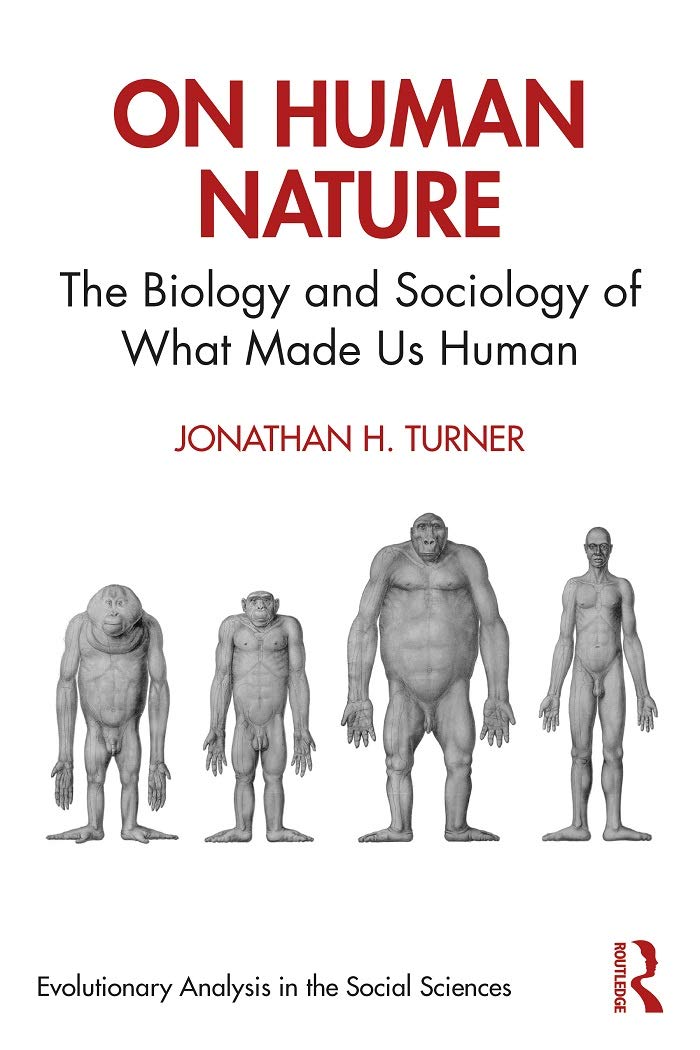
In this book, Jonathan H. Turner combines sociology, evolutionary biology, cladistic analysis from biology, and comparative neuroanatomy to examine human nature as it was inherited from common ancestors shared by humans and present-day great apes. Selection pressures altered this inherited legacy for the ancestors of humans--termed hominins for being bipedal--and forced greater organization than extant great apes when the hominins moved into open country terrestrial habitats. The effects of these selection pressures increased hominin ancestors' emotional capacities through greater social and group orientation. This shift, in turn, enabled further selection for a larger brain, articulated speech, and culture along the human line. Turner elaborates human nature as a series of overlapping complexes that are the outcome of the inherited legacy of great apes being fed through the transforming effects of a larger brain, speech, and culture. These complexes, he shows, can be understood as the cognitive complex, the psychological complex, the emotions complex, the interaction complex, and the community complex.


Comments
Post a Comment